
Bring it back
- Reviews of what you finished earlier
- At most a third of your time
- Answers first, then the check
Warm up
Renfy turns anything you want to learn into a short daily workout, with a patient tutor beside you and a memory that won't let it fade.
No sign-up to try. Start with a 7-day free trial.
Try one set
Learn one idea, answer one question, then recall it. That is a set. No sign-up, nothing to install.
Sample set, step 1 of 3: learn
Right after you learn something, you forget it quickly. Then the forgetting slows down. Each time you bring it back just as it starts to slip, it fades more slowly than before. That is why the same hour of study, spread over several days, sticks longer than the same hour in one sitting.
You learn a new idea on Monday. When is the best time to go over it again?
Pick one to see what the tutor says.
Tutor, on the answer Straight away:Not quite, and it is a very natural guess. Going over it straight away feels good because it is still easy, and easy practice does little for memory. The better moment is a day or so later, when it takes a little effort to pull back.
Tutor, on the answer A day or so later:Yes. A day later it has started to slip, so bringing it back takes some effort, and that effort is what makes it last. The next gap can then be longer: a few days, then a week.
Tutor, on the answer The night before:That gets many people through one exam, and most of us have done it. But it fades again within days. The same time spread out keeps it far longer, so a day or so after learning is a better moment.
Sample set, step 2 of 3: recall
Say it to yourself in your own words first. Then check.
One way to put itGo over it just as it starts to slip, then wait a little longer each time.
How did yours compare?
Sample set, step 3 of 3: done
You had it, so the next gap can be longer.
Not yet is fine. That is exactly what the coming back is for.
In the real thing, this comes back tomorrow, then in 3 days, then 7.
This is a sample, so nothing here is saved. The real tutor adapts to you: your goal, your pace and your answers.
How a day works
No endless feed and no guilt. Renfy plans today's session for the time you have, and tells you when to stop.

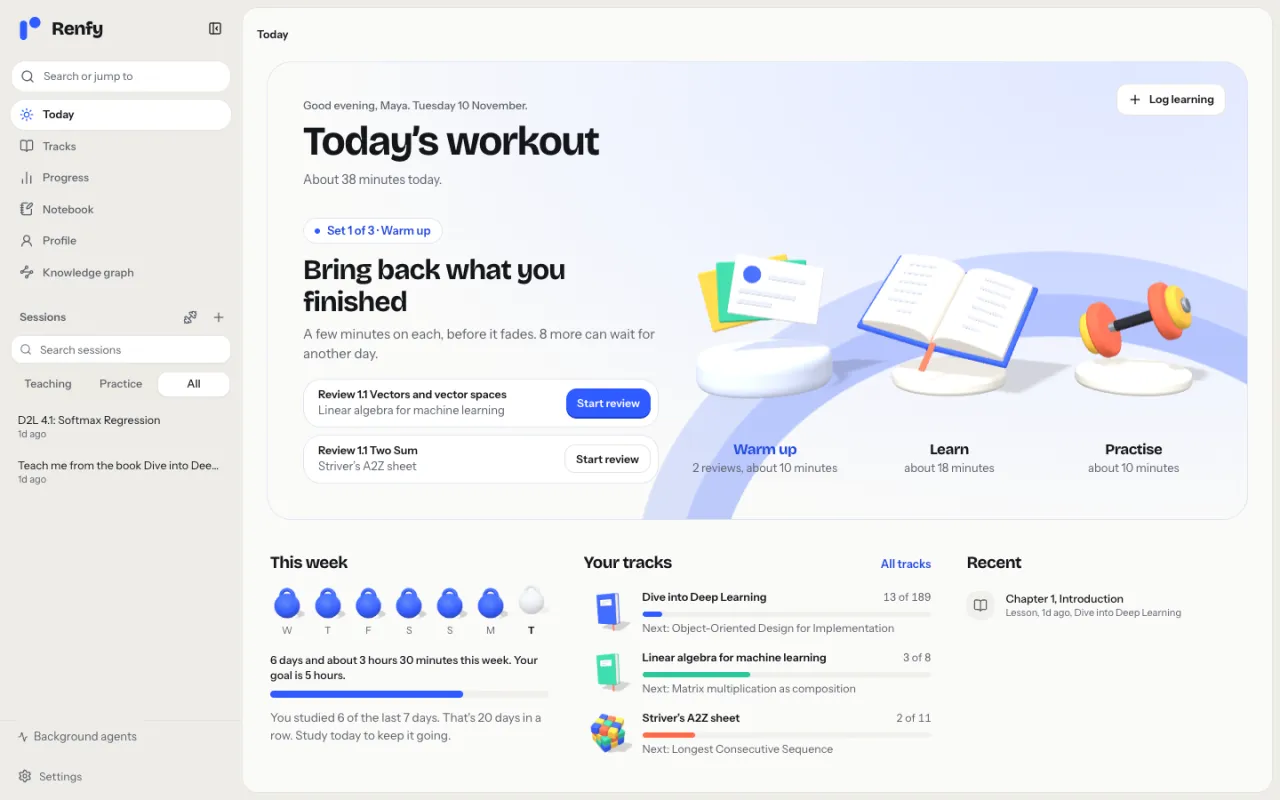
Screenshots on this page use sample data.
What makes it stick
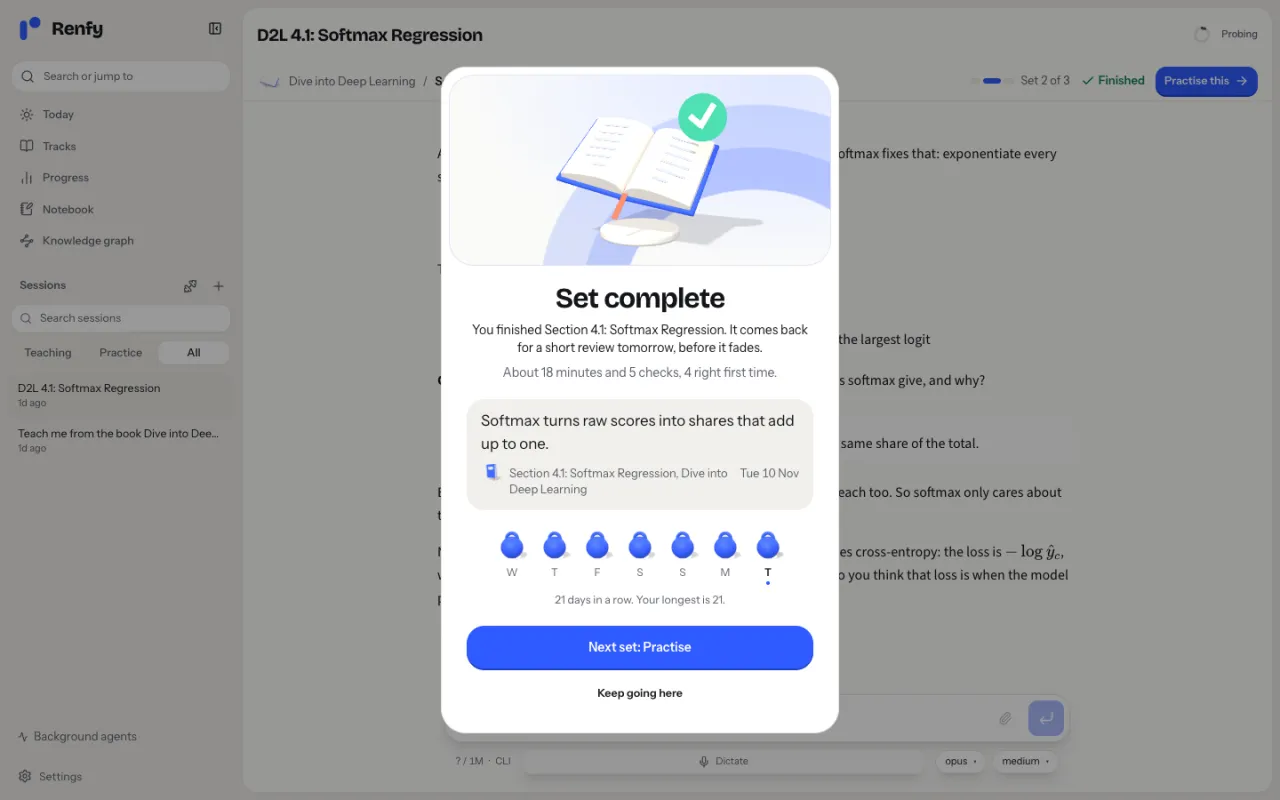
Everything you finish comes back for a short review after 1, 3, 7, 14, 30 and 60 days: right when it is about to fade.
Spaced reviews
Finish a lesson and Renfy books it to return after 1, 3, 7, 14, 30 and 60 days, each time as a short check just before it would fade.
Takeaways and recall
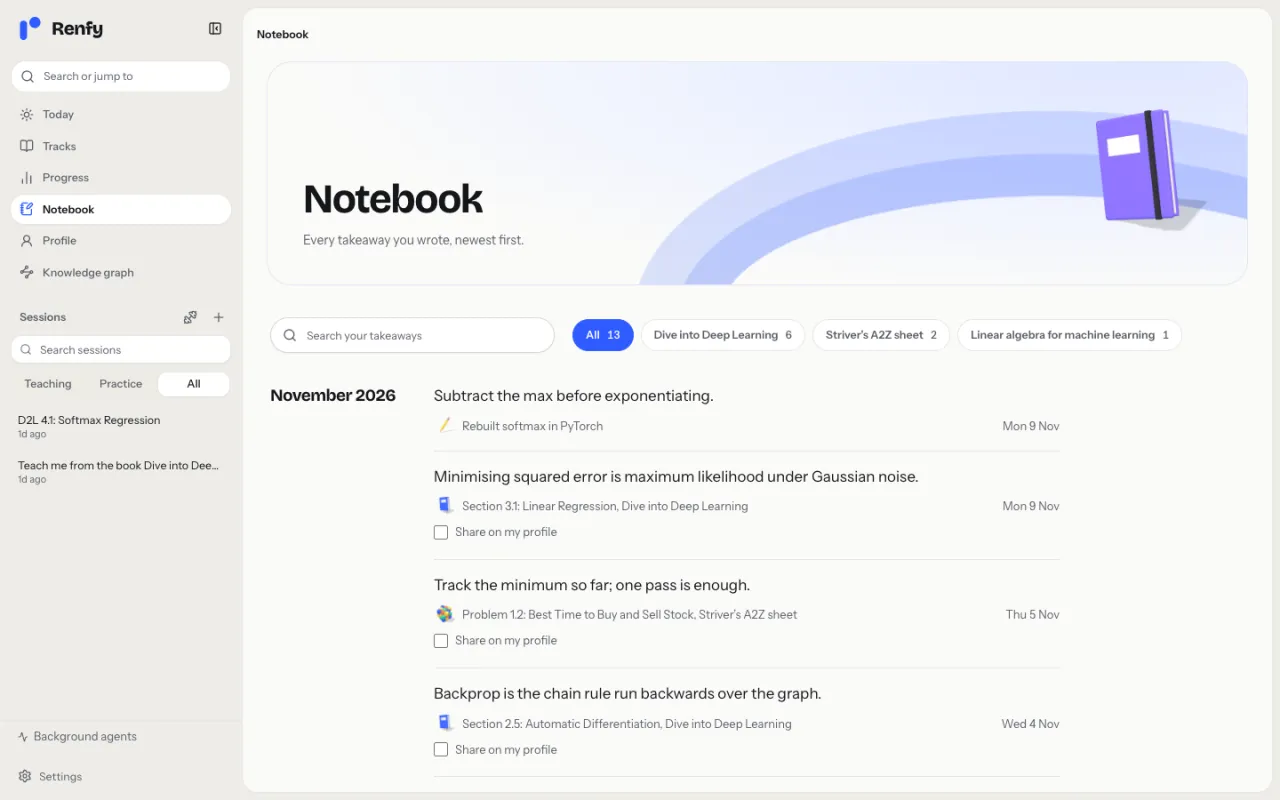
End a section with a one-line takeaway. Every one lands in your notebook, and comes back in your reviews and in short recall drills, so you remember your own words instead of rereading.
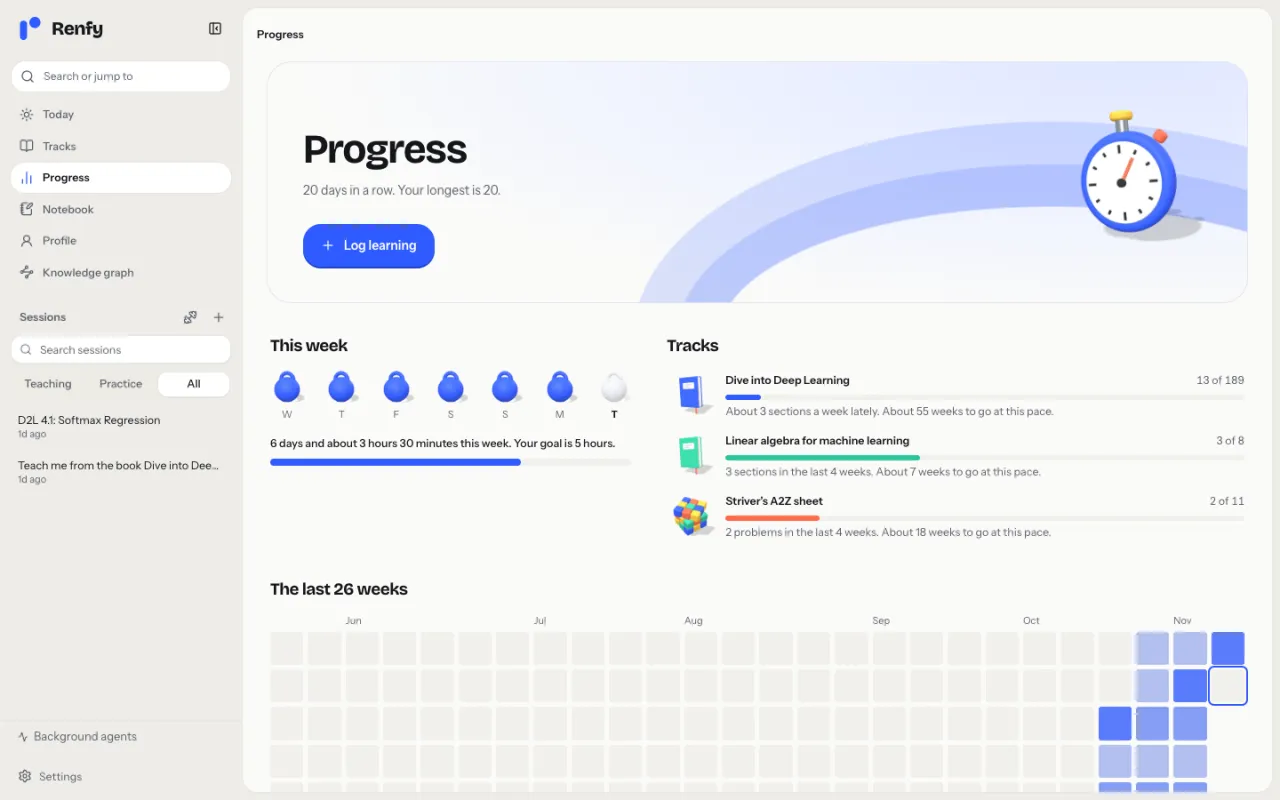
Your week in review
A weekly goal you set, a calendar of the last 26 weeks, and each track's pace and finish estimate. Time is an honest estimate, never padded.
Tracks for any subject
Start from one of eleven ready-made tracks, paste a reading list you already have, or tell the tutor your goal and it designs a plan from the best free material on the web.
Ready-made tracks, or have one built for your goal
When Maya says she's very sure, she is right about 9 times in 10.
A profile that can't be faked
Here is what an example profile looks like. Not trophies or streak counts. Your public page shows what you know today, how well it has held up, and how honest your confidence is.
Simple prices
Start with a 7-day trial, about four half-hour sessions. Then pick the pace that suits you.


